Rocket Science
How to get into orbit, and stay there.
Saturday, February 9, 2008
To get into outer space you go up, right? Well, yes, if that's all you want to do, and if you don't mind coming back down to Earth again right quick. This, in fact, is just what the new "Space Tourist" companies are doing. The most advanced of these companies: Virgin Galactic plans to use its "SpaceShipTwo" to rocket straight up to an altitude of over 62 miles and then fall and glide back to Earth. Why 62 miles high? Because (by somewhat arbitrary definition) this is the boundary line past which is considered "Outer Space".
Does that mean that SpaceShipTwo will hang out with the International Space Station? No, because SpaceShipTwo never goes into orbit. Instead it goes straight up until it runs out of fuel, and then it free falls back to the Earth. The whole trip takes about two and a half hours, and has only about six minutes of weightlessness. By comparison the ISS is in orbit and is constantly in weightlessness.
So what's the difference between the ISS and SpaceShipTwo? That is, what's the difference between just getting into space and staying there? Or, in one more form, what's the difference between just going up and going into orbit? The answer is speed, and lots of it.
Counter-intuitively that speed needs to be horizontal rather than vertical. That is, to get into orbit you need to go fast parallel to the surface of the Earth, not perpendicular to it.
The next time the Space Shuttle launches, hop onto NASA TV,
and watch the launch. You'll note that as the shuttle (or
any rocket) gets higher and higher (into thinner and
thinner air) it starts to tilt over.
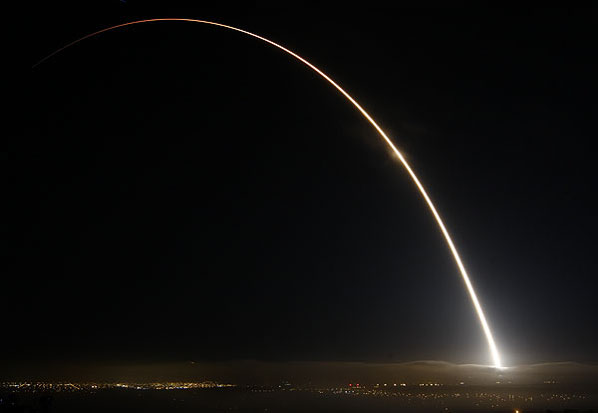 As you continue to
watch the launch on those long range tracking cameras that
NASA uses you can see that the shuttle is rocketing almost
parallel to the Earth. It's hardly going up any more.
This is because the real work to be done to get into orbit
is to get going fast horizontally. In fact the only reason
a rocket really needs to go up at all is to get out of the
atmosphere which slows you down too much to attain orbit
(at least without melting first).
As you continue to
watch the launch on those long range tracking cameras that
NASA uses you can see that the shuttle is rocketing almost
parallel to the Earth. It's hardly going up any more.
This is because the real work to be done to get into orbit
is to get going fast horizontally. In fact the only reason
a rocket really needs to go up at all is to get out of the
atmosphere which slows you down too much to attain orbit
(at least without melting first).
If you didn't sleep through high school physics then you've probably seen some version of the classic cannon ball explanation of orbit.
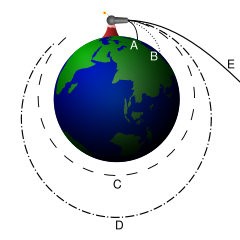
From Wikipedia: http://upload.wikimedia.org/wikipedia/commons/7/73/Newton_Cannon.svg
The idea is as you put more and more gunpowder into your cannon you shoot the cannon ball further and further. As the ball travels gravity pulls it down. If you shoot the ball fast enough then it falls down as the Earth curves away underneath it! This is, in essence, what orbit is.
Unfortunately this cannon ball description of orbit, while accurate, does a disservice to the understanding of just how fast you have to go to be in orbit. Personally I like to think of throwing a baseball. In order to put a baseball into orbit (ignoring the affects of the atmosphere) you'd have to throw the baseball to the horizon! That is, you have to throw the baseball so fast that as it curves down it doesn't fall into your neighbor's yard, or the next block, or even the next state, but instead falls down as the Earth curves away underneath it. You have to throw the ball to where the sun sets! I think that gives a better idea of just how fast orbit is.
This is why the Space Shuttle and other rockets are monsterously large, and by comparison SpaceShipTwo is hardly larger than a private Lear jet. The energy you need to just go up to the edge of space is a fraction of the energy you need to go fast enough to stay there.
If the Earth didn't have an atmosphere, or better, if you were on the Moon, and you had a really really strong arm then you could orbit a baseball simply by throwing it to the horizon. If you did that in an atmosphere, that tremendous speed you have to give the ball would mean it would burn up almost instantly due to friction with the air. This is exactly what happens when a meteor enters the air. It melts so fast and so hot that we see it streak through the night sky.
This then is why we really go up to get into orbit. Not because that's where space is, but to get out of the atmosphere. To orbit things that have no air (the Moon or asteroids for example) you only have to go up enough to not hit things on the ground.
PS: I've written a follow-up article to this: De-Rocket Science
Some additional sources:
- Excellent source of detail from Robert A. Braeunig (linked to from JPL)
- JPL Basics of Space Flight, Chapter 3. Gravitation and Mechanics
- JPL Basics of Space Flight, Chapter 5. Planetary Orbits
- JPL Basics of Space Flight, Chapter 14. Launch Phase
- Randy Culp, another layman
- How Stuff Works: orbits
- NASA: Orbital Mechanics 101
- NASA: How Orbital Motion is Calculated
- .mil Space Primer
- Glenn Elert, another layman